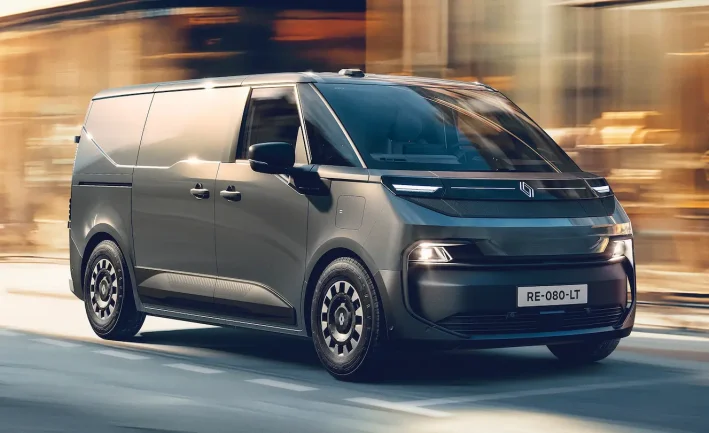
Best Medium Electric Van contender
The all-new Renault Trafic E-Tech represents a complete reinvention of Renault’s medium electric van strategy. Rather than updating the existing Trafic Electric, Renault has developed an entirely new generation of electric commercial vehicle built from the ground up around an 800V architecture and software-defined vehicle platform. Developed through the Flexis joint venture between Renault, Volvo Group and CMA CGM, the new Trafic E-Tech is designed specifically for the next era of connected, high-efficiency electric commercial transport.
This is not simply an electrified version of the current diesel Trafic. The new model has been engineered as a dedicated EV from the outset, allowing Renault to rethink packaging, aerodynamics, charging capability and usability. The result is a van that combines compact external dimensions with highly competitive payload, range and charging performance.
At launch, the new Trafic E-Tech will be available with two battery options. Entry-level versions are expected to use a smaller 59kWh LFP battery delivering around 217 miles of WLTP range, while long-range models use a larger 81kWh NMC battery capable of up to 279 miles WLTP range. Renault has also confirmed a future urban-focused battery option using LFP chemistry to reduce costs and improve sustainability.
Power comes from a new rear-mounted electric motor producing 150kW (204hp) and 345Nm of torque. Unlike many front-wheel drive electric vans, the rear-wheel drive layout improves traction under load while also helping maximise steering lock and manoeuvrability. Renault claims the new platform delivers a turning circle of just 10.3 metres — smaller than several superminis.
Perhaps the most significant technical development is the adoption of 800V charging technology — something rarely seen in the commercial vehicle sector. Renault claims the Trafic E-Tech can charge from 15-80% in around 20 minutes using DC rapid charging, dramatically reducing downtime compared with current-generation electric vans.
Despite its compact proportions, practicality remains highly competitive. L1 models offer 5.1m³ of cargo volume, while larger L2 variants increase that to 5.8m³. Payload is expected to reach up to 1.25 tonnes, while towing capacity stands at up to 2,000kg. Importantly, the vehicle remains under 1.9 metres tall, allowing access to height-restricted car parks and urban environments.
The new Trafic E-Tech also introduces Renault’s software-defined vehicle architecture, allowing over-the-air updates, advanced fleet integration and scalable connected services. Combined with up to 18 driver assistance systems and vehicle-to-load functionality, the van has clearly been designed around modern fleet operation rather than simply electrification alone.
Crucially, Renault has managed to create something that feels genuinely forward-looking. The Trafic E-Tech is not merely replacing a diesel van with batteries — it is rethinking what a medium electric van should be in terms of efficiency, charging, connectivity and urban usability.
What’s it like?
We’ll let you know, once we’ve driven it…